A Head Start on Belonging at Rutgers

New Student Orientation helps thousands of incoming students find community, confidence, and their place on campus.
In a matter of days, a small city's worth of new first-year and transfer students will converge on Rutgers University–New Brunswick from across New Jersey, America, and the world.
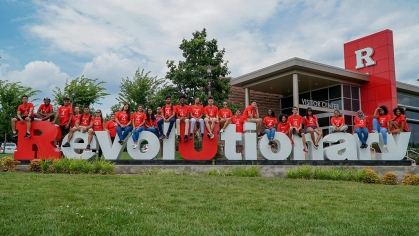
Nearly 7,000 of those incoming students have taken a simple step for a head start on their college transition: Over the summer, they attended two-day New Student Orientation sessions offered by Student Orientation and Transition Programs within the Division of Student Affairs.
According to post-orientation surveys, four of five attendees said the orientation helped them feel more confident about starting at Rutgers; make new friends they'll meet up with during the first days of the new semester; and feel prouder than ever about joining one of the nation's top-ranked public universities.

For Priya Soundar, an incoming pre-med student from small-town New Hampshire, New Student Orientation was about making this vast, faraway institution feel smaller, friendlier, and more like home.
"I chose Rutgers because it offers so many research opportunities that can help my path to a medical career, but I was afraid of making friends and fitting in," said Soundar, who will attend the School of Environmental and Biological Sciences. "So many Rutgers students are from New Jersey. As someone from out of state, I wanted to make sure I could become part of the community."
By the end of orientation, those worries faded.
"It wasn't just the tours that helped us feel comfortable on campus, or learning about the resources that help students," Soundar said. "We made so many friends within our orientation group. I made friends in the suite I stayed in overnight. All of us ended up meeting so many new people and having so many conversations we might not otherwise have had."
Student Affairs held more than 20 New Student Orientation sessions between June and August, hosting more than 300 incoming students per session for walking and bus tours, small group icebreakers and games, and personalized information sessions.
Attendees learn to fill out course schedules, keep track of their academic progress, and manage financial aid information.
They discover student success resources that will help them stay on track amid the ups and downs of campus life—from Academic Advising and the Learning Centers, to Student Health and counseling services; from the One Stop Student Services Center to the Offices of the Dean of Students–Advocacy, Outreach, and Support; from Career Exploration and Success to the Student Basic Needs Center.
They learn the intricacies of Rutgers' busing and parking systems, what to bring for living on campus, how to make the most of life as a commuter student, and how to make the most of their meal plans.
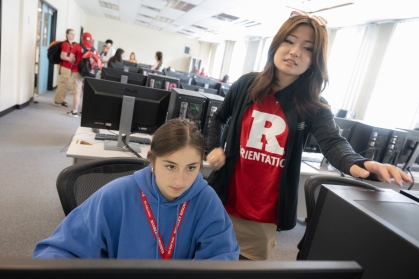
Victoria Byra, an incoming School of Nursing student from central New Jersey, chose Rutgers for, among many other reasons, its school spirit, football pride, Greek life, and close-knit community. Plenty of her older classmates are now Scarlet Knights.
"But it's easy to be nervous about leaving home, living on your own, getting used to sharing space in the dorms," Byra said.
New Student Orientation helped her become excited about the transition. "We all bonded with each other, and with the roommates we were assigned at orientation. We realized that it's new for all of us. We also bonded over Rutgers facts: The origin of the first drug treatment for tuberculosis, the origin of college football. This college, so close to my hometown, is the birthplace of so much for America and the world."
Nilya Taylor knows how powerful those orientation-made connections can be. A rising senior studying psychology and pursuing a 4+1 master's degree in elementary education, she has served New Student Orientation as a student leader for the past two years.
"I am one of the first welcoming faces that new students see when they come to Rutgers," Taylor said. "I get so much out of helping them connect with the resources that help students meet their goals. It's rewarding to help ease a lot of their nerves and help make students feel confident."
Taylor continued, "A lot of them come in not knowing anyone. The longer we spend time together, I see more of their personality. And they leave with new friends."
Soundar agreed.
"As I left orientation, I felt so sad to leave all these new people who were like, 'We wish you lived in New Jersey so we could hang out over the summer!' I'm excited to see them back on campus," Soundar said. "And if I can talk with new people at orientation, I can make other new friends as well."