Where Involvement Leads: Rutgers Students Build Bridges With Global Impact

How many civil engineering majors can say they wrapped up their first year of college by traveling halfway around the world to build a bridge that will last five decades, save lives, and help hundreds of people reach essential resources?

Ula Sokolowski and Eugene Yu can, thanks to their involvement in the Rutgers University–New Brunswick chapter of Engineers in Action (EIA), a national nonprofit that partners with university teams to build infrastructure in underserved communities worldwide. They spent the 2024-25 academic year planning a 350-foot pedestrian bridge in the southern African nation of Eswatini—and traveled to that country to help build the bridge last summer.
Their entry to this high-impact learning experience came through two Division of Student Affairs initiatives designed to help students find and connect with student organizations that align with their goals and interests: The annual Involvement Fair on College Avenue and the getINVOLVED online directory.
Joining a registered student organization is a foundational experience for many students, a way to find community and direction, and a way to jump-start future careers by building skills and forging connections, said Chris Carey, Assistant Vice Chancellor for Campus Engagement and Belonging. “Whoever you are as a student, whatever your major or life interests, you are likely to find one or more student orgs that can help you grow as an individual, a scholar, and a future professional,” Carey said. “And finding the right organization has never been easier.”
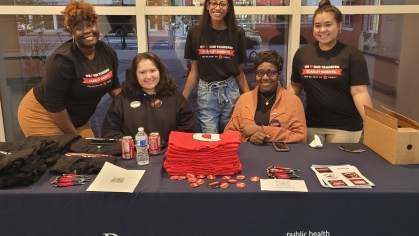
Sokoloski joined Rutgers in Fall 2024 with an interest in the Civil Engineering major but a fear that its math and physics requirements would be too intense. But those fears melted away at the Involvement Fair, an outdoor festival in which some 700 student organizations set up informational booths before the start of fall classes.
There, in the event’s section for engineering-themed organizations, she found Engineers in Action. “They had everything I was looking for. Bridge-building. International travel. I knew this was the organization for me,” she said.
Yu, also a first-year student in Fall 2024, wanted an opportunity to jumpstart his civil engineering career by taking on a big, skill-building challenge. He also wanted opportunities for volunteer work. His search of the getINVOLVED page turned up a few promising organizations. “I attended their interest meetings and found that EIA was the perfect match because its projects are driven and results-focused.”
Building Bridges, Halfway Round the World

Sokolowski, Yu, and the Rutgers EIA team spent that academic year working with EIA groups at the University of Iowa, Hofstra, and others on fundraising, planning, and logistics for what became the Imphumelelo Suspension Footbridge, a span of steel, concrete, and wood across Eswatini’s Ingwavuma River. From June through August 2025, they joined a 10-member student cohort on site to build it in collaboration with area residents and Eswatini’s Ministry of Economic Planning.
That summer, Sokolowski served as quality control manager, overseeing concrete verification, measurements, and documentation. Yu took on the role of safety manager, ensuring that all team members and community volunteers wore proper protective equipment, followed construction protocols, and maintained a safe worksite.
“We got to live and work face-to-face with the people who are going to benefit from the bridge for its lifespan, at least the next 50 years,” Yu said. “People from the community showed up every day as volunteers to help build it with us.”
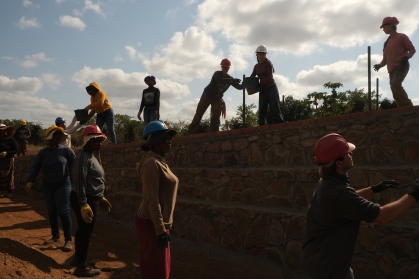
He described Eswatini as beautiful but challenging, a place without pervasive potable water or electricity. Seeing firsthand how the bridge would connect residence with healthcare, schools, and safe passage was deeply meaningful.

The completed bridge, now reportedly the country’s second-largest of its kind, serves about 1,500 residents, dramatically reducing travel distances and improving safety. During the previous three years, attempts to walk across the river had led to several deaths and injuries.
Today, Sokolowski and Yu are serving as the Rutgers EIA chapter’s co-president and treasurer, respectively. This year, they are helping lead the group’s next big project: A suspended footbridge over the Nkomazi River, also in Eswatini, with construction planned for the summer of 2026. The new site brings new challenges, including the logistics of crossing a deeper river that’s home to crocodiles and hippos. As always, there are also significant fundraising needs. The students continue to raise money for last year’s costs as well as this year’s build.
Sokolowski and Yu won’t be traveling to Eswatini this summer, however. “It’s important to share the opportunity with others,” Sokolowski said, “though I’m so jealous of the students we’ll be sending.”
Carey said the leadership and practical skills these students have developed, so early in their undergraduate career, are “exactly what we hope to spark through the Involvement Fair, getINVOLVED and our hundreds of student organizations. That’s the power of experiential learning, especially when it leaves the classroom and crosses the world.”